
"Chinese coffee growing areas"
2000 article(s) found

As a traditional western drink, how does coffee develop in the Chinese market?
Coffee, as a traditional western drink, has a long history and cultural heritage. The world consumes at least 400 billion cups of coffee every year, and the current annual global coffee consumption is about 10 million tons. Coffee is the first of the two largest drinks in the world, and it is also the second largest trading commodity in the world after oil. China's coffee industry has been introduced and developed with the development of reform and opening up.

China's coffee consumption will maintain an annual growth rate of about 20%
For coffee to be truly successful in China, it will have to convince less-visited regions that coffee can complement or even replace tea, especially for some unique coffee varieties. The Wall Street Journal website once reported that as the economic development slows, China's commodity demand may be slowing down, but in a country with a tradition of drinking tea, coffee is even more expensive.

Where should China's coffee industry go at the crossroads?
Yunnan net (Reporter Fang Min) China's coffee industry has been under the crackdown of foreign multinational corporations. If foreign companies own a general term and use it as a special commodity name, then large companies like Nestl é, you only need to sit and collect coffee shop partner infringement fees, and China's coffee industry will never rise to prominence. When an industry develops to a certain stage, the public

How can Yunnan small grain coffee enter the international market? The Coffee Dream of Chinese Cafe Farmers
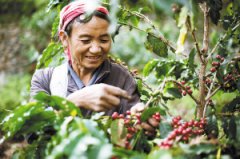
Professional Coffee knowledge Exchange more information on coffee beans Please follow the coffee workshop (official Wechat account cafe_style). It was sunny in Pu'er, the main coffee producing area in China, on the afternoon of the weekend. Liao Xiugui, a 77-year-old farmer in Xiaoguzi Coffee Manor in Nandaohe Village on the outskirts of the city, is making coffee to cheer her up. Outside the window, 300 mu of coffee forest, lush. This is the best coffee in the area.
Yunnan Coffee and Chinese Coffee Market
Coffee trees need high altitude, tropical climate and fertile soil to grow the best coffee beans. Such climatic conditions on earth surround the equator, about between 25 degrees north latitude and 30 degrees south latitude. This zone, commonly known as the golden coffee belt, belongs to tropical and subtropical regions and is technically called coffee belt. When it comes to coffee in the world, let's talk about Chinese coffee first.
How far is China from a coffee consumer?
In Fushan Town, located in a corner of western Hainan Province, the fragrant coffee shops are full all the year round. The local residents consume more than 200 cups of coffee per capita every year. This amazing consumption makes coffee suppliers from all over the world who come here to participate in the International Barista Championship admire.

Introduction of domestic coffee beans _ origin of Chinese coffee beans _ how much is a cup of Yunnan small-grain coffee
Professional coffee knowledge exchange more coffee bean information please follow the coffee workshop (Wechat official account cafe_style) Yunnan small grain coffee belongs to Rubiaceae, mainly grown in Lincang, Baoshan, Pu'er, Dehong, Nujiang, Xishuangbanna and other places. Small-grain coffee originated in Ethiopia and Arabian Peninsula, and was introduced into China by the British until 1892.

Introduction of Chinese Fine Coffee beans Yunnan small granule Coffee
Due to the unique geographical environment and climatic conditions, Yunnan coffee has formed a unique flavor of strong but not bitter, fragrant but not strong, with a little fruit flavor. World-class coffee experts evaluate it as the best coffee in the world, and its cultivation techniques. The yield per unit area is also world-class. Coffee is rich in protein, fat, sucrose, starch, caffeine and other substances.
Chinese coffee machinery enters Africa to grow coffee beans.
Abstract: the development of African coffee market provides a new platform for China's food machinery industry. Pang Lu, Chinese Economic and Commercial Counsellor in the Republic of C ô te d'Ivoire, believes that this is a rare opportunity for China's food machinery export. Among the products called black gold by Africans, in addition to oil, there is also coffee. Coffee is the main cash crop in Angola, the primary export of Burundi and the former one.

China wants to export coffee to become a major global coffee production base
China's coffee production and consumption China believes it has enough strength to compete with the world's two largest coffee producers: Brazil and Colombia, which produce 5.12 million bags and 1.25 million bags (60kg each), respectively. These two countries account for more than 50% of global coffee production. Vietnam in Asia relies on the cultivation of robusta coffee (robusta).

Katim Coffee Taste and Flavor description method introduction of varieties in manor production area
Katim coffee flavor description method the introduction of varieties in the manor producing area is an example of this absurd hypothesis. Traditionally, we would bring Arabica tin card to Binchuan Jugula as the starting point of Chinese coffee, but the real starting point of modern Chinese coffee industry is to grow Katim for Nestl é in order to earn foreign exchange. When the boutique coffee industry started, we only had
What does Chinese coffee trees look like? where are coffee trees planted in Yunnan? environmental production areas manor treatment plants.
What does the Chinese coffee tree look like? where do the coffee trees grow in Yunnan? the manor processing plant introduced that the coffee fruit should be harvested immediately, and because the fruit of different ripening periods will appear on the same tree, it is not easy to harvest. Generally speaking, it takes as long as 4-5 months to receive a full harvest from the initial harvest. If ripe and immature fruits are harvested at the same time, the coffee will be reduced.

Is there a place to grow Arabica beans in China? are Arabica coffee beans expensive?
Professional coffee knowledge exchange more coffee bean information Please pay attention to Coffee Workshop (Wechat official account cafe_style) although China has been growing coffee for more than 100 years, especially in the past few decades, the reality is that there is still little interest in Chinese coffee in the world. Fortunately, in recent years, the Chinese government, local manufacturers, multinational bakers, industry organizations, etc.
Chinese Coffee Culture Coffee Legend of Zhukula Village, Dali, Yunnan Province
When it comes to the history of Chinese coffee, we have to mention Yunnan Dali Zhukula Coffee, which plays a vital role in the history of Chinese coffee. The ancient coffee forest in Zhukula Village is a unique variety of small-grain coffee in Yunnan. It is very rare and of excellent quality. It can be called a living fossil of Chinese coffee. In today's program, we will explore the century-old coffee legend of Zhukula Village. Zhu

What kind of Yunnan small-grain coffee tastes good? what are the flavor and taste characteristics of Yunnan Hongmi coffee?
Professional coffee knowledge exchange more coffee bean information please follow the coffee workshop (Wechat official account cafe_style) the pride of Chinese coffee people Yunnan Lujiangba Zimo Manor mention Yunnan I believe that the first thing that every literary and artistic young woman will think of is the reputation of having the most desirable tourist destination in the world: Lijiang is one of our Chinese.
It is still not optimistic for Chinese coffee to break out of the "price winter" industry.
In late March, coffee harvest is coming to an end in Yunnan Province, which accounts for more than 99% of China's coffee acreage and output. Affected by the international market, after more than two years of "price winter", the purchase price of coffee beans has soared this year, from about 13 yuan per kilogram to about 25 yuan at present.
Taiwanese businessmen build Chinese coffee brands in the old revolutionary base areas of the mainland
Huang Wenguang, a Taiwanese businessman in his late sixties, gathered with friends at his coffee sightseeing park. Viewed from the viewing terrace halfway up the hillside, 100 mu of coffee trees planted along the hillside are leafy and green; cups of coffee give off a delicate fragrance at hand. Coffee made in China that is not bitter, sour or astringent can also have such a good quality. Huang Wenguang said that with the development of economy, China

World Coffee Manor: Manzhongtian Coffee Manor has been certified by the Rainforest Alliance.
(photo caption: Manzhongtian Manor appearance) recently, the Manzhong Tian Coffee Manor of Aiji Group has successfully passed the on-site audit certified by the Rainforest Alliance, becoming one of the Rainforest Alliance certified coffee farms in China. This is another country that Aidan Coffee has obtained after passing EU Organic Certification, Chinese Organic Certification, Starbucks CP Certification and Pu'er Origin Certification, the first Chinese coffee capital.

The Historical Origin of Xinglong Coffee is Xinglong overseas Chinese Farm 1961 Coffee good? Xinglong coffee price
Professional coffee knowledge exchange more coffee bean information please follow coffee workshop (Wechat official account cafe_style) Xnglng coffee pinyin: Xinglong coffee (Xinglong Kafei) catalogue 1 historical origin 2 Xinglong coffee reputation 3 Xinglong coffee stir-frying 4 geographical indications protection 4.1 protection range 4.2 quality and technical requirements 4.3 quality features 4.4 special logo use
Demand Analysis of Chinese Coffee Industry in 2014
According to China Industrial Insight Network researchers: in late March, coffee harvest is coming to an end in Yunnan Province, which accounts for more than 99% of China's coffee acreage and output. Affected by the international market, after more than two years of "price winter", the purchase price of coffee beans has soared this year, from about 13 yuan per kilogram to about 25 yuan at present.